
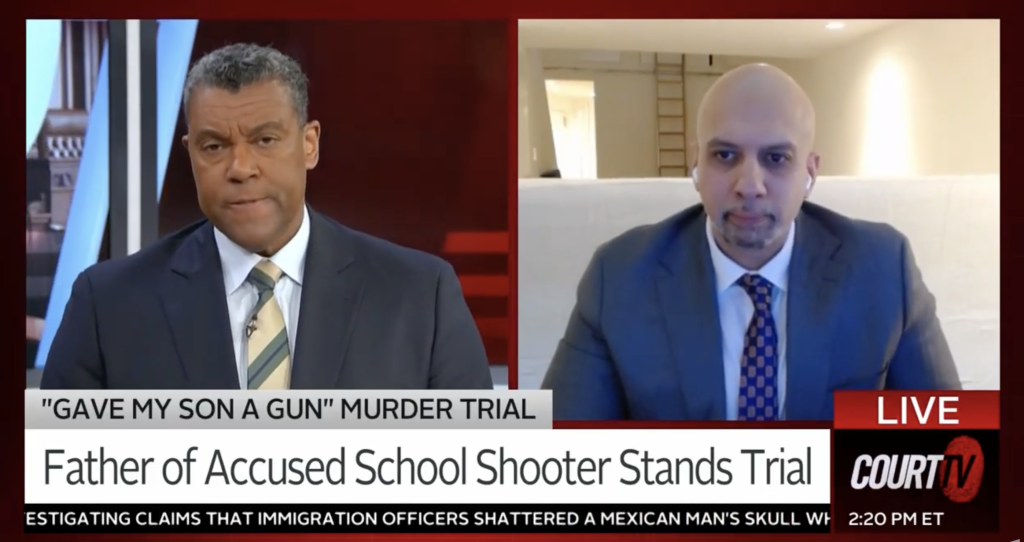
Experienced trial attorney Gabriel Sepulveda-Sanchez joins Court TV Live to discuss one of the most consequential criminal trials in the nation: the prosecution of Colin Gray, father of the accused Colt Gray. As testimony unfolds in Georgia, the case raises urgent questions about parental responsibility, gun ownership, and the legal limits of foreseeability. Read about Gabriel’s other Court TV appearances aquí.
Authorities say Colin Gray allowed his teenage son to use the gun that killed two people at Apalachee High School. The gun, prosecutors said, belonged to Colin Gray, who they claim gifted it to his son months before the shooting. Colin Gray reportedly never expected his son to commit such a crime. Was this massacre unpredictable or preventable?
A Father, a Gift, and a Legal Reckoning
Access and responsibility have been the prosecution’s themes since day one. Investigators say Colin gave his son the weapon for Christmas. He also allegedly neglected to lock it up despite red flags about his teen’s mental health and behavior.
Gabriel explains that gun ownership carries inherent obligations, especially when minors are involved.
“It’s okay to give your son or kid a gift as a gun, but you have to be responsible for the possession of that gun still while in the house,” Gabriel says.
Colin Gray faces nearly 30 charges, including second-degree murder and involuntary manslaughter…not for pulling the trigger, but for allegedly enabling access to the weapon. For jurors, the key question is deceptively simple: what did the father know, and when did he know it?
“I think there should be some liability on the parents… Did he knowingly give his son a weapon when the warnings were there?” Gabriel explains, “That is beyond a bad parenting decision, that’s a disregard for human life.”
The distinction between poor judgment and criminal negligence may determine Colin’s fate.
Foreseeability: The Legal Line Between Tragedy and Liability
The prosecution argues that the shooting was not an isolated or unpredictable event. They claim Colt had exhibited troubling behavior, including signs of emotional decline and possible fascination with prior mass shootings. If Colin knew (or reasonably should’ve known) about these risks, prosecutors argue he had a legal duty to act.
The defense, however, paints a different picture. They suggest the father’s intentions were benign. According to statements made to police, Colin gave the gun as a way to bond with his son, to pull him away from isolation and encourage outdoor activities like hunting.
Gabriel acknowledges this from firsthand experience. “Speaking as a gun owner, as someone who knows guns and grew up hunting, the number one rule is, if there are minors in the house, you have to make sure that your firearms are locked up and protected,” he says.
The case forces jurors to examine the thin line between trust and responsibility and whether failing to act can carry criminal consequences.
The Power of the 3D Crime Scene
One of the most striking moments in the trial came during testimony from investigators who presented a detailed 3D scan of the school. The virtual reconstruction allows jurors to move through hallways and classrooms, retracing the alleged shooter’s steps.
Gabriel explains that the prosecution is using these reconstructions strategically.
“My understanding is that the jurors were being protected from some of the graphic images of the victims in the shooting. They’re doing what they can to humanize and make an emotional impact on the jurors,” he says. “They can’t show the graphic carnage, but they can give the jurors a glimpse of what the chaos was like, and…you can kind of place yourself there and see what happened without showing the graphic.”
This approach reflects a fundamental truth about jury trials: they are decided not only through logic, but through human perception.
“In a perfect world, jurors will decide cases on logic alone,” Gabriel notes. “But as defense lawyers, in dealing with human beings, you want them to feel the emotions and really kind of step into that situation in order to feel that.”
Prosecutors aim to help jurors understand the digital wreckage so they can comprehend what was lost and why responsibility matters.
Parenting, Protection, and the Law
Gun ownership and parental responsibility have also become hot topics across the country as a result of the case.
“That’s why there are these laws that hold parents accountable for the acts of their children while they’re minors: negligence and revision laws, [and] child engagement laws,” he explains. “Those laws are made because most minors don’t have the emotional maturity to make decisions for themselves.”
Even in the absence of warning signs, he says, safe storage is essential.
“If you’re going to give your son a gun as a gift, you still have to understand that he’s a minor, even without those warning signs of idolizing mass shooters or exhibiting signs of mental health behavior,” Gabriel adds. “When you give your child a weapon, you still have to house that or hold that weapon responsibly.”
What the Jury Must Decide
Jurors are being presented with an immense challenge as this testimony carries on. Not only will they have to piece together what happened during the shooting itself, but they will also have to visualize the unseen series of decisions that led up to it.
Could this shooting have been predicted? Did Colin Gray turn a blind eye to red flags? Or was he a father who was shocked by something no father should ever expect to see? The outcome of this trial will decide if this becomes a case that sets a precedent or a cautionary tale with no criminal charges.
For Gabriel, the stakes extend far beyond one courtroom.
“I think it’s an important discussion that the nation needs to have. What are the limitations on this issue?” he says. “Those rules are in place especially for minors, because they just don’t have the mental maturity and capacity to understand the nature and consequences of all their actions.”
As the trial unfolds, the nation watches closely. The verdict will not undo the loss, but it may redefine the legal boundaries of accountability in an era increasingly shaped by questions of access, foresight, and responsibility.
Read more analysis from Gabriel Sepulveda-Sanchez and his appearances on Court TV.
FAQs from a Law Firm’s Perspective
What does “foreseeability” really mean in court?
Legally, foreseeability asks whether a reasonable person in the defendant’s position would have predicted or anticipated the harm.
Were there obvious warning signs (threats, written behavioral concerns, specific predictions of violence)? If so, the prosecution is going to say the injury was foreseeable. The defense will say no reasonable parent could have foreseen this.
Is giving a firearm to a minor automatically criminal?
No. Gifting a gun or allowing access to one (under supervision) isn’t illegal in Georgia or most places. Once it becomes unsupervised, unlocked, and careless under the circumstances, it becomes illegal.
The state’s theory doesn’t rest on the original gift of the gun. The charge is based on what allegedly occurred after his mother raised concerns.
How does criminal negligence differ from bad parenting?
This is easily the most crucial question. Bad parenting doesn’t break any laws. Criminal negligence means that someone was so careless or indifferent that their actions far exceeded how a reasonable person would have acted.
Jurors would have to find that Colin’s behavior wasn’t simply inappropriate…but criminal. Either reckless or negligent to a degree that would rise to the level of a crime.
Watch the full episode here: