
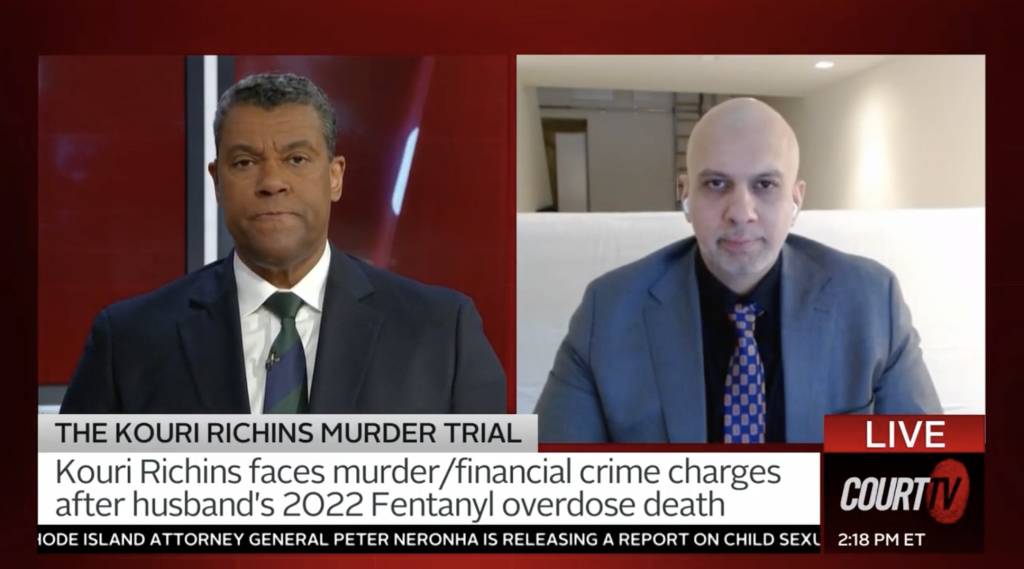
Experienced trial attorney Gabriel Sepulveda-Sanchez joined Court TV Live to discuss the high-profile murder trial of Kouri Richins, the Utah woman accused of poisoning her husband, Eric Richins, with fentanyl.
Prosecutors allege Richins killed her husband for financial gain and to pursue a new life with another man. But as testimony unfolds, the case highlights a central challenge in criminal law: when the evidence is largely circumstantial, how much proof is enough to convince a jury beyond a reasonable doubt?
Life Insurance as Motive: Suspicious or Simply Circumstantial?
One prosecution theme centers on the life insurance policies the couple purchased before Eric died. Prosecutors have argued the policies show a money motive. But Gabriel warns there will likely be more skepticism than that over a few insurance forms.
“Just because you’re applying for life insurance policies… and then someone dies shortly after… doesn’t mean that your partner is guilty of murder,” Gabriel explained.
Life insurance is common among married couples, particularly those with children or shared financial responsibilities. Jurors may view these policies as routine planning rather than evidence of a murder plot.
Gabriel noted that the prosecution must ultimately prove far more than the existence of insurance coverage.
“I think it’s a circumstantial case,” he said. “You’re gonna need to show that she had access to fentanyl [and] that the victim wasn’t predisposed to it… I think you’re gonna need a lot more than this to show that she actually poisoned her husband and killed him.”
Without direct evidence, such as eyewitness testimony, clear forensic links, or a confession, the state must weave together many small facts to build a compelling narrative.
Financial Pressure and the Question of Motive
Prosecutors have also emphasized the Richins family’s financial struggles, suggesting debt may have motivated the alleged crime. However, Gabriel pointed out a potential weakness in that theory.
“If you’re millions in debt, and you’re getting $100,000 payoff, you’re gonna need a lot more than that to put a dent in that debt,” he explained.
According to testimony, the life insurance payout being discussed was relatively modest compared with the family’s reported financial obligations. For jurors, that raises an obvious question: if someone were planning a calculated financial murder, why would the payoff be so small relative to the debt?
Gabriel emphasized that such inconsistencies could weaken the state’s argument.
“It doesn’t mean it doesn’t help to pay some of that debt down,” he said, “but it’s still not strong enough to me.”
In criminal trials, motive can help explain why a crime occurred, but it is not required for a conviction. Prosecutors must still prove the defendant committed the act itself. Still, when the motive appears unclear or weak, jurors may hesitate.
The Fentanyl Allegation
At the center of the prosecution’s case is the allegation that Eric Richins died after ingesting fentanyl mixed into his drink. Fentanyl is a powerful opioid often used medically for severe pain, but also widely associated with overdose deaths when misused.
Prosecutors claim Kouri Richins secretly administered the drug in a Moscow Mule cocktail. The theory relies heavily on forensic findings and circumstantial connections between the defendant and the drug. Gabriel noted that connecting those dots convincingly will be critical.
The prosecution must demonstrate not only that fentanyl caused Eric’s death, but also that the defendant obtained the substance and deliberately administered it. Without that clear chain of evidence, reasonable doubt may emerge.
A Divorce Consultation: Evidence or Coincidence?
Another moment that caught attention during the trial was testimony from a divorce attorney who had met with Eric approximately two years before his death. Prosecutors suggested the meeting may have contributed to tensions in the marriage, and possibly provided a motive for the alleged crime. Gabriel, however, questioned how much weight jurors will give that testimony.
“How many people go to divorce attorneys just to get a consult? They’re not sure if they want to get divorced or rethinking it,” he said.
Consulting with a divorce attorney is often exploratory rather than decisive. Many people seek legal advice simply to understand their options. A consultation alone does not indicate imminent separation, nor does it suggest someone’s life is in danger.
“Just because you want to get divorced doesn’t mean you feel like your life’s in jeopardy,” Gabriel explained.
Without evidence that Eric feared for his safety, the meeting may carry limited weight with jurors.
The Challenge of a Circumstantial Case
Cases built largely on circumstantial evidence often hinge on narrative coherence. Jurors must decide whether the prosecution’s explanation of events is the most logical interpretation, or whether reasonable alternatives exist.
Gabriel emphasized that the state will need to present a fuller picture before the case is complete.
“I think the prosecution’s got to get this case and put on some better evidence,” he said.
That doesn’t mean circumstantial cases cannot succeed. In fact, many convictions rely heavily on indirect evidence. But the pieces must fit together convincingly. Each detail, from insurance policies to financial records to forensic findings, must reinforce the same conclusion. If even a few elements feel speculative, jurors may hesitate to convict.
How Jurors May Be Evaluating the Evidence
During deliberations for a trial like this, jurors will flip back and forth between two stories. The prosecution presents a story of premeditation driven by money and relationships.
The defense will argue that prosecutors are taking ordinary life events (talking about insurance, money problems, marriage problems) and weaving them into a narrative with no smoking-gun evidence.
Gabriel hints at this balance that jurors must consider. Mere suspicion doesn’t cut it for conviction. Instead, prosecutors must prove that the evidence rules out all doubt.
What Comes Next in the Trial
As testimony continues in the trial of Kouri Richins, both sides will continue presenting evidence aimed at shaping the jury’s understanding of Eric Richins’ death.
For the prosecution, the focus will likely remain on strengthening the chain of evidence surrounding the alleged fentanyl poisoning. Defense attorneys will likely continue attacking holes, inconsistencies, and alternate narratives.
The outcome will ultimately depend on whether jurors believe the state has proven its theory beyond a reasonable doubt. For legal observers like Gabriel Sepulveda-Sanchez, the case serves as a powerful example of how complex criminal trials can become when direct evidence is scarce.
Circumstantial details may raise suspicion, but in the courtroom, suspicion must evolve into proof.
FAQs From a Legal Perspective
Is circumstantial evidence enough to convict someone of murder?
Yes. Many criminal convictions rely heavily on circumstantial evidence. However, the evidence must collectively prove guilt beyond a reasonable doubt.
Why does motive matter if it isn’t required for conviction?
Motive helps jurors understand why a crime may have occurred. When the motive is unclear or weak, jurors may be less confident in the prosecution’s theory.
How important is forensic evidence in poisoning cases?
Extremely important. Prosecutors must prove not only that a poison caused the death but also that the defendant had access to it and deliberately administered it.
Does meeting with a divorce attorney prove that a marriage was ending?
Not necessarily. Many people seek legal advice about divorce without ever filing. Jurors typically view such consultations as exploratory unless supported by additional evidence.
Watch Gabriel Sepulveda-Sanchez’s full legal analysis and other appearances here or on our YouTube channel.